Are you a student of IGNOU MA Rural Development (MARD) programme? Do you need help with your IGNOU MARD Project Dissertation MRDP 1? You have come to the right place.
At mbahelp.in, we help IGNOU students prepare their MRDP 01 Solved Dissertation quickly and correctly. Many students find the MRDP 001 project work difficult, confusing, or time-consuming because of job pressure, family responsibilities, and lack of research experience. We are here to make it easy for you.
What is IGNOU MRDP 001 – Field Work and Dissertation in Rural Development?
MRDP 001 is the Project Work course for IGNOU MA Rural Development (MARD) programme. Its full name is “Field Work and Dissertation in Rural Development”. It is offered by the School of Continuing Education (SOCE), IGNOU. This is a compulsory course and you cannot get your MARD degree without completing it.
In this course, you have to:
- Choose a topic related to rural development
- Write a project proposal and get supervisor approval
- Do actual fieldwork and collect data from respondents
- Analyze the data using statistical methods
- Write a full dissertation with 5 to 8 chapters
- Get it signed by your supervisor and submit the bound copy to IGNOU
When to Start IGNOU MRDP 001 Project Work – Right Time and Preparation
This is the most common question students ask. According to IGNOU guidelines, you should start your IGNOU MRDP 001 project work only after completing the following three compulsory theory papers:
- MRD-101 – Rural Development: Indian Context
- MRD-102 – Rural Development Programmes in India
- MRD-103 – Rural Development: Planning and Management
Once these three papers are done, you should read two important documents before starting: the Programme Guide and the MRDP 001 Project Work Handbook. Both are provided by IGNOU and contain all rules and formats.
Preliminary Preparation Steps Before Starting MRDP 01 Project
Here is a simple checklist you should follow before starting your IGNOU MARD project report:
- Complete MRD-101, MRD-102, and MRD-103 theory papers
- Read the MRDP 001 Project Work Handbook carefully
- Contact your Study Centre Coordinator to get a supervisor assigned
- Think about a topic that matches your work area or state
- Read the suggested topic list given in Part III of the Handbook
- Discuss your topic idea with your supervisor
- Start preparing the draft project proposal
NOTE: Remember: Your supervisor will guide you throughout. Without supervisor approval, you cannot start the actual study. Contact your Study Centre Coordinator as early as possible to get a supervisor.
How to Select Topic for IGNOU MRDP 001 – Topic Selection and Supervisor Consultation Guide
Topic selection is the first and most important step in your IGNOU MARD Project Dissertation MRDP 1. A wrong topic can waste your time and energy. Here is how to choose the right topic:
Factors to Keep in Mind While Selecting MRDP 001 Topic
- Suitability: The topic should match your educational background and course material.
- Relevance: The topic should be useful and related to rural development in your area.
- Availability of Literature: You should be able to find some earlier studies or books on the topic.
- Time Available: The topic should be practical to complete within your available time.
- Finance: Data collection should be possible within your budget.
- Feasibility: You should be able to collect data within the time-frame.
- Distance: Choose a study area that is not too far from your place of stay.
- Local Knowledge: You should know the local language and customs of the area.
- Contacts: Having contacts in the area makes data collection easier.
IGNOU has listed 192 suggested topics in the MRDP 001 Project Work Handbook under various categories. Some broad category areas are given in the table below:
| Category | Sample Topics |
| Women Empowerment | Role of SHGs, economic independence, political participation of rural women |
| Health and Nutrition | Rural health care, ICDS evaluation, maternal health, malnutrition |
| Panchayati Raj | Functioning of PRIs, grassroots planning, rural administration |
| Agriculture | Green Revolution impact, land reforms, crop husbandry, cooperative farming |
| Education | Dropout rate, adult literacy, non-formal education, educational backwardness |
| NGOs and Voluntary Sector | NGO approaches, people’s participation, voluntary agency management |
| Rural Poverty | Poverty alleviation, rural indebtedness, bonded labour, IRDP impact |
| Tribal and SC Development | Impact of schemes, socio-economic development, empowerment programmes |
| Technology and Media | IT in rural development, role of TV, folk media, communication methods |
| Environment | Rural sanitation, hygiene, water supply, environmental health |
NOTE: Important: Never select a topic that is already chosen by another student known to you. IGNOU will reject duplicated or copied dissertations. The topic must be original and approved by your supervisor.
List of IGNOU MARD Project Topics 2026
- A study of the factors affecting rural under development
- A study of the effectiveness of the strategies of rural development planning
- Impact of Five Year Plans on rural development
- Reasons for progress in rural development programmes
- Importance of evolving new strategies for rural development
- Analysis of the extent of grassroots level participation in rural development
- Rural Development policies and grassroots level realities
- Exploration of the welfare aspects in rural development
- Impact of IRDP on Tribes
- Impact of IRDP on Scheduled Castes
- A study of the approaches of NGOs to rural development
- Salient features of rural development schemes after independence.
- Comparative study of the characteristics of rural and urban communities in India
- Comparative study of the characteristics of tribal and peasant communities
- A study of traditional practices in rural cultivation
- A study of the patterns of migration in rural India
An analysis of the extent to which caste system is practiced in rural India - A study of the role of voluntary agencies for rural development
- A study of the relevance of Jajmani system
- An analysis of rural power structure in India
- A study of the trends in agricultural growth (in your state)
- Importance of animal husbandry for rural development
- A study of non-governmental activities in rural India
- An analysis of the contribution of rural credit markets
- A study of the importance of rural employment
- A study of the characteristics of rural workforce
- An analysis of wage system in rural India
- Agriculture as a source sustaining economic growth
- A study of the extent of equality/inequality in land distribution
- A study of the problems faced by rural credit markets
- Extent of rural poverty in India
- A description of the incidence of rural poverty
- A critical analysis of poverty alleviation programmes
- A study of the agrarian system
- A study of the agrarian system and classes
- A study of the feudalistic agrarian system
- A study of capitalistic agrarian system
- A study of agrarian movements in India
- A study of agrarian movements in India
- A study of the approaches to land reforms
- Impact of abolition of intermediary tenures
- A study of the shift from cooperative to contract farming
- A study of the problems associated with land reforms
- A study of the strategies for green revolution
- A study of the impact of green revolution on income and employment
- A study of the problems and their consequence on Green Revolution
- A study of challenges to agricultural development due to globalization
- Impact of agriculture extension services after independence
- A study of the extent and nature of privatisation of rural extension services
- Problems and challenges in rural extension services
- A study of the organizational and administrative aspects of extension services
- A study of the problem faced in administrative linkages from national level to village level.
- A study of the functioning of Panchayati Raj Institutions
- An analysis of the problems faced by rural development functionaries
- A study of the effectiveness of the Panchayati Raj Institution for Rural Development
- An analysis of the impact of Panchayati Raj Institutions
- A study of the contribution of cooperatives towards rural development
- An analysis of the functioning of credit cooperatives
- A comparative study of the contribution of credit and non credit cooperatives in rural India
- A comparative study of the features of cooperative and other enterprises
- A study of the problems faced by cooperatives in rural India
- An analysis of the relevance of cooperative organizations in a mixed economy
- A study of the role of credit societies in rural development
- A study of the impact of non institutional credit in India
- Analysis of the functioning of credit cooperatives and micro-credit societies
- A study of the extent of social changes in rural India after independence
- An analysis of the role of self help groups in women’s empowerment
- A study of the extent of economic independence of rural women
- A study of the extent of social empowerment of rural women
- A study of the extent of economic empowerment of rural women
- A study of the political management by rural women
- Involvement of rural women in agriculture
- Role of voluntary agencies in the empowerment of rural women
- A study of the role of mass media for rural development
- A study of the role of print media for rural development
- A study of the impact of television in rural development
- A study of the role of information, education and communication (IEC) in rural development
- A study of the relevance of communication technology for rural development
- A study of the innovative uses of information technology for rural development
- A study of resources available for rural development and their utilization
- A study of the extent of people’s participation in rural development planning
- Analysis of the strengths and weaknesses of decentralised planning
- A study of the nature and process of district level planning for rural development
- An evaluation of block level planning for rural development
- A study of grassroots level planning for rural development
- A study of the effectiveness of rural development management
- An evaluation of management and administration of rural development projects
- A study of the effectiveness of rural development projects for socio-economic development
- An evaluation of the effectiveness of rural development projects in social development
- A study of the extent of effectiveness of rural development projects
- A study of the costs and benefits involved in rural development projects
- Need-based study of rural development project proposals
- A study of the effectiveness of the monitoring system for rural development projects
- A study of the dimensions of rural development project evaluation
- A study of the role of Government in promoting voluntary action for rural development
- An analysis of the factors responsible for people’s participation in rural development
- A study of the problems of NGOs working in rural sector
- An analysis of the strengths and limitations of NGOs in rural sector
- An analysis of voluntary agency administration in rural sector
- A study of the effectiveness of the management of projects by NGOs
- An analysis of the effectiveness of community-based programmes
- A study of programme-formulation strategies in community-based programmes
- A study of social action strategies in rural development
- A study of the impact of grassroot-level organizations in rural sector
- A study of the social status of rural women
- A study of the political status of rural women
- A study of economic status of rural women
- A study of educational status of rural women
- A study of the social and educational status of girls in rural India
- An analysis of the impact of various schemes for rural girls’ education
- A study of the factors contributing to the educational backwardness of rural women
- An analysis of the key indicators of rural women’s health and nutrition status
- A study of the policies and programmes for health and nutrition of rural women
- A study of the initiatives for the empowerment of rural women
- A study of the factors influencing rural women’s empowerment
- A study of the extent of child labour in rural India
- A study of the educational status of rural children
- A study of the health status of rural children
- A study of the policies and programmes for health and nutrition for rural children
- A study of the status of non formal education of rural children
- An evaluation of ICDS programmes in rural India
- A study of the success of empowerment programmes of Schedule Castes
- A study of the success of empowerment programmes of Scheduled Tribes
- A study of the impact of various schemes for the development of Scheduled Tribes
- A study of the socio-economic development programmes for Schedule Castes
- A study of socio-economic development programmes of Schedule Tribes
- A study of rural indebtedness
- A study of the child bonded labour
- A study of bonded women labour
- Socio-economic status of artisans and craftsmen
- A study of the state of rural industries
- A study of the status of agricultural labourers
- Contribution of Khadi and Village industries to rural development
- A study of the extent of legal knowledge among rural masses
- A study of the rural health care facilities in India
- Problem faced in rural health care
- A study of the indicators of health in rural area
- A study of the determinants of rural health
- A study of different diseases common in rural areas
- A study of the linkages between health and development
- A study of the role of NGOs in rural health care
- A study of rural health services after independence
- Role of primary health care centers in rural health services
- A study of health and nutrition status of young girls in rural India
- A study of health and nutrition status of children in rural India
- A study of health and nutrition status of pregnant women in rural India
- A study of the factors influencing health and nutrition status in rural India
- A study of the problems relating to malnutrition in rural India
- A study of different models of health care delivery in rural India
- A study of communicable diseases in rural India
- A study of the problems associated with communicable diseases in India
- A study of the interventions in the area of controlling communicable diseases
- A study of the management of health care system in rural India
- An evaluation of national immunization programme in rural context
- A study of the national malaria control programme
- A study of the national tuberculosis control programme
- A study of illiteracy-eradication programme
- A study of the extent of the awareness about HIV/AIDS in rural India
- An evaluation of guinea worm eradication programme
- A study of rural sanitation programme
- A study of the factors influencing environmental sanitation and hygiene in rural India
- A study of the status of maternal and child health in rural India
- An evaluation of reproductive and child health programmes in Rural India
- An analysis of policies of schemes for rural health care
- A critical analysis of national family welfare programme
- A study of rural health care planning
- People’s participation in rural health care programme
- An analysis of monitoring and evaluation system of rural health care
- A study of rural health care education in India
- A study of communication in rural health care
- A study of innovative health programmes by NGOs for rural India
- A study of communication models for rural development
- A study of various communication channels in rural development
- A study of various methods of communication for rural development
- An evaluation of the contribution of folk media in rural development
- A study of the emerging electronic information technology for rural development
- Impact of television in rural development
- A study of rural extension programme
- An analysis of the performance of rural extension programmes
- A study of the government efforts in extension services in rural development
- A study of community initiatives for extension programme in rural India
- A study of Panchyati Raj Institutions in rural India
- An analysis of IRDP programmes
- A study of the role of CAPART in rural development
- An analysis of animal husbandary in rural India
- An analysis of village industries in rural India
- An analysis of rural health extension
- An analysis of rural education extension
- A study of various extension methods
- A study of different kinds of communication methods used in extension work
- A study of communication problems in rural development
- A study of extension management
- A study of strategies for extension
How Supervisor Consultation Helps in IGNOU MARD Project Dissertation MRDP 1
After choosing a topic, always discuss it with your supervisor. A good discussion with your supervisor will help you to:
- Finalize and refine the topic title
- Identify the correct objectives for your study
- Develop proper hypotheses if needed
- Choose the right universe and sampling framework
- Decide the tools for data collection
- Avoid common mistakes in project proposal writing
Always prepare a draft project proposal before going to meet your supervisor. This shows that you are serious about your work and helps your supervisor guide you better. It also makes getting quick approval easier.
IGNOU MRDP 001 Project Proposal Format – Complete Guidelines for MARD Students
The MRDP 1 project proposal format is one of the most asked-about topics by IGNOU MARD students. Your project proposal should be about 10 pages long. It is submitted only to your supervisor — not to IGNOU headquarters or Regional Centre. Once approved, attach the original signed copy before binding your final dissertation.
Complete Format of IGNOU MRDP 001 Project Proposal
The table below gives you the complete format with all 11 required sections:
| Section No. | Section Name | What to Write |
| 1 | Project Title | Clear, brief, specific. Related to your field of work. Include state/district. |
| 2 | Introduction | Describe the topic, broad area, why it is important, key concepts. |
| 3 | Statement of the Problem | Briefly explain the problem, its relevance, and gap in existing studies. |
| 4 | Objectives | Write 3 to 4 clear objectives. Use serial form. State scope of study. |
| 5 | Hypothesis (if any) | Write probable answer to the problem. Not always needed. Discuss with supervisor. |
| 6 | Universe of the Study | Define the full area or population. Example: all households in selected village. |
| 7 | Sample | Choose sample from universe. Mention method: random, cluster, stratified, etc. |
| 8 | Tools for Data Collection | Mention tools: interview schedule, guide, observation guide, case study format. |
| 9 | Data Analysis Plan | Mention statistical methods: percentage, mean, median, SD, correlation, etc. |
| 10 | Tables | Explain how tables will be numbered and interpreted (3-paragraph method). |
| 11 | Chapter Plan | Give tentative list of all chapters with brief description of each chapter. |
Key Points to Remember While Writing MRDP 001 Project Proposal
- The project proposal is a guide for your entire study. Write it carefully.
- Keep the title clear, short, and specific. Add state or district name in the title.
- Objectives should be 3 to 4 in number. Use words like “to study”, “to analyze”, “to evaluate”.
- Hypothesis is optional for small surveys of about 100 respondents. Discuss with your supervisor.
- The universe is the total population of your study. Sample is selected from the universe.
- Recommended sample size for MRDP 001 is about 100 respondents.
- Sampling methods can be random, cluster, stratified, or multi-stage stratified.
- Tools can be interview schedule, interview guide, observation guide, or case study format.
- The chapter plan should list all chapters with a brief 2–3 line description of each.
NOTE: The approved project proposal must be attached to the dissertation before binding. Do not mail the proposal to IGNOU headquarters. Only your supervisor needs to approve it.
IGNOU MARD Project Report MRDP 01 Solved Dissertation – Complete Chapter Structure and Contents
A complete IGNOU MARD Project Dissertation MRDP 1 should have 5 to 8 chapters. The ideal chapter length is about 20 pages each. No chapter should be too short or too long. Below is the standard chapter structure:
| Chapter | Title | Approx. Pages |
| Chapter 1 | Introduction | ~20 pages |
| Chapter 2 | Research Design and Methodology | ~20 pages |
| Chapter 3 | Profile of Respondents / Study Area | ~20 pages |
| Chapter 4–6 | Data Analysis and Interpretation | ~20 pages each |
| Chapter 7 (Optional) | Case Studies | ~15–20 pages |
| Last Chapter | Summary, Findings, and Recommendations | ~20 pages |
What Each Chapter Should Contain
Chapter 1 – Introduction: Explain the topic, why it is important, and give a brief review of past studies (review of literature). Clarify important concepts used in the study.
Chapter 2 – Research Design and Methodology: Explain how the study was done, step by step. Include objectives, hypothesis, universe, sample size, sampling method, and tools used.
Chapter 3 – Profile of Respondents / Study Area: Describe the people you studied. Include data on age, sex, caste, income, education, occupation, and other social and economic details.
Chapter 4, 5, 6 – Data Analysis and Interpretation: Each chapter covers 1 to 2 objectives. Include 5 to 7 tables per chapter. Each table interpretation must have three paragraphs: (i) brief introduction to the topic, (ii) interpretation of data, and (iii) major findings.
Chapter 7 (Optional) – Case Studies: Include 1 to 2 case studies of individuals or institutions. Use a case study guide format with personal data, family background, social life, and specific area of concern.
Last Chapter – Summary, Findings, and Recommendations: Give major findings of the entire study in brief. Write practical suggestions or recommendations. Also mention areas for further research.
IGNOU MARD Project Dissertation MRDP 1 Report Writing Format – Complete Guidelines for MARD Dissertation
This section explains the IGNOU MARD fieldwork report writing service format that every student must follow. IGNOU has given clear instructions about how the report should be written and presented.
Typing and Page Format for IGNOU MARD Project Dissertation MRDP 1
- Font Size: 12 point (12pt)
- Line Spacing: Double space throughout the document
- Paper Size: A4 size (29 x 20 cm)
- Typing Style: Computer-typed (preferred). Handwritten not accepted.
- Margins: Standard 1-inch margins on all sides
- Page Numbers: Page numbers must be given on all pages
Binding and Cover Page Format
- Binding Type: Hard cover binding only. Loose or spiral binding is NOT permitted.
- Cover Colour: Light rose colour (official SOCE colour)
- Copies Required: Two copies – one for IGNOU, one personal copy
- First Page Must Include: Your name, enrolment number, full address, and supervisor name
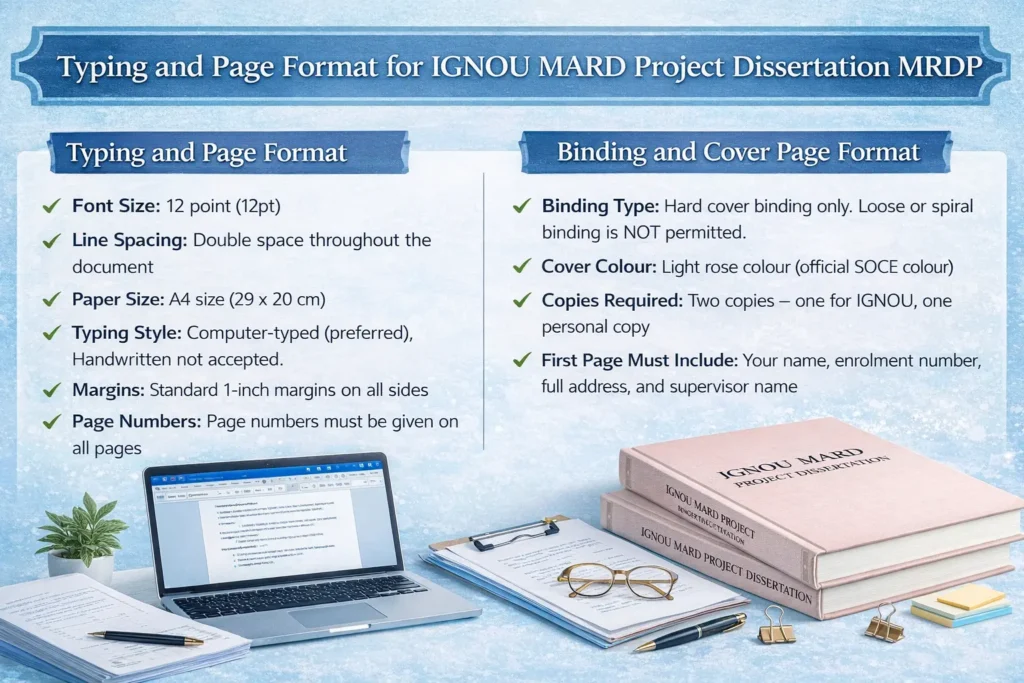
Table Format and Interpretation Rules in IGNOU MRDP 001 project report
Tables are very important in your IGNOU MARD Project Dissertation MRDP 1. Follow these rules for every table:
- Number tables chapter-wise: Chapter 1 tables are 1.1, 1.2, 1.3, etc. Chapter 2 tables are 2.1, 2.2, etc.
- Give a brief and clear table title after the table number.
- If a table is taken from another source, mention that source below the table.
- Each table must be followed by a 3-paragraph interpretation:
- First paragraph: Brief introduction to the parameter or topic being discussed in the table.
- Second paragraph: Detailed interpretation of the data shown in the table. Mention all percentages and important figures.
- Third paragraph: Major findings from the table. Focus on the majority responses.
You should have about 5 to 7 tables per chapter. Do not fill chapters with too many tables. Rest of the findings can be written in narrative (paragraph) form.
Other Required Pages and Documents for IGNOU MARD Project Dissertation MRDP 1
- Table of Contents – list all chapters and page numbers
- List of Tables – give table numbers, titles, and page numbers
- List of Diagrams or Figures (if any)
- Preface – brief note about the study
- Acknowledgement – thank your supervisor, respondents, and others who helped
- Declaration (Annexure V format) – signed by student
- Supervisor Certificate (Annexure VI format) – signed by supervisor
- Bibliography – list all books, reports, and sources at the end
- References – can be given at the end of each chapter
- Appendices – include interview schedules, questionnaires, and other tools used
- Approved Project Proposal – attach original signed copy before binding
NOTE: Always show the final typed draft to your supervisor before binding. The supervisor must verify and certify the work before you submit it to IGNOU.
Where to Submit IGNOU MARD Project Dissertation MRDP 1 – Submission Address and Process
After completing your IGNOU MARD Project Report MRDP 01 and getting it bound, you need to submit it to IGNOU. Here is the complete submission process:
Submission Address for IGNOU MRDP 001 Dissertation
The Registrar
SR&E Division
Indira Gandhi National Open University (IGNOU)
Maidan Garhi, New Delhi – 110068
How to Submit Your IGNOU MARD Dissertation MRDP 001
- By Registered Post: Send the bound copy by registered post to the above address.
- By Hand: Submit it in person at the IGNOU headquarters in New Delhi.
- Keep one copy: Always keep the second copy with you. IGNOU will NOT return the submitted copy.
Important Points for IGNOU MARD Project Dissertation MRDP 1 Before Submission
- The final typed draft must be shown to your supervisor before binding.
- Get your supervisor’s certificate (Annexure VI) signed before binding.
- Your signed declaration (Annexure V) must be included inside the dissertation.
- The approved original project proposal must be attached before binding.
- Check for typing errors, page numbers, and correct table placements.
- Make sure the cover is light rose hard cover. No spiral or loose binding.
- Title page must have your name, enrolment number, full address, and supervisor details.
NOTE: IGNOU takes about 4 to 6 months to evaluate the dissertation and declare results. The evaluation is done by a pool of experts from across India. Plan your submission accordingly.
How mbahelp.in Helps You with IGNOU MARD Project Dissertation MRDP 1
We have been providing academic assistance to IGNOU students since 2010. We have helped thousands of students across India complete their IGNOU MARD Project Dissertation MRDP 1 successfully. Our team has deep knowledge of rural development subjects, IGNOU format rules, and research methodology.
Complete Services We Offer for IGNOU MRDP 001
- Complete Project Proposal (10 pages): Title, introduction, objectives, hypothesis, universe, sample, tools, data analysis plan, and chapter plan.
- Full Dissertation (5–8 chapters): Complete report in IGNOU format – double space, 12pt, A4, all pages included.
- 100% Original and Unique Work: Fresh content for each student. Customized to your state, district, and area.
- All Required Pages: Title page, declaration, supervisor certificate, TOC, list of tables, bibliography, appendices.
- Interview Schedules and Questionnaires: As per IGNOU Annexure format for villagers, grassroot leaders, and project staff.
- Data Tables with Full Interpretation: Tables numbered chapter-wise (1.1, 1.2, etc.) with 3-paragraph interpretation.
- Ready to Print and Submit: The file you receive is ready to print, bind, and submit directly to IGNOU.
| Step | Action | Details |
| Step 1 | Contact Us | WhatsApp/Call 9911899400 with your enrolment no. and topic interest |
| Step 2 | Discuss Requirements | We understand your area, state, district, supervisor preferences |
| Step 3 | Get Project Proposal | We prepare 10-page proposal. Get supervisor approval. Changes if needed. |
| Step 4 | Receive Full Dissertation | Complete 5–8 chapter report as per chapterization plan |
| Step 5 | Print, Bind and Submit | Light rose hard cover. Submit one copy to IGNOU. Keep one copy. |
Popular IGNOU MRDP 001 Dissertation Topics We Cover
We cover all major topic areas in the IGNOU MARD Project Report MRDP 01. Here are some popular topics that students frequently choose:
- People’s participation in rural development programmes
- Role of Self Help Groups (SHGs) in rural women’s empowerment
- Impact of MGNREGS / NREGA on rural employment and income
- Functioning and effectiveness of Panchayati Raj Institutions
- Study of rural health care facilities and challenges
- Impact of microfinance on rural women entrepreneurs
- Role of NGOs in rural development and poverty reduction
- Child labour and bonded labour in rural India
- Rural sanitation, hygiene, and health awareness programmes
- Factors affecting rural education and high dropout rates
- Impact of Green Revolution on rural income and employment
- Role of cooperatives in rural credit and development
- Rural indebtedness, poverty, and poverty alleviation programmes
- Tribal development and Scheduled Caste welfare programmes
- Impact of digital technology and mass media in rural development
If you have your own topic in mind, contact us. We will guide you on how to make it suitable for your state, block, or district for the IGNOU MA Rural Development dissertation help.
Why Choose mbahelp.in for IGNOU MRDP 01 Project Report?
- 15+ Years Experience: Helping IGNOU students since 2010. Trusted by thousands of students.
- 50+ Universities Covered: IGNOU, BITS Pilani, Amity, UPES, Andhra University, and more.
- 100% Original Work: Every report is freshly written for each student. No copied content.
- Strictly Follows IGNOU Format: Double space, 12pt, A4, light rose cover, all annexures included.
- On-Time Delivery: We always deliver before your submission deadline.
- Affordable Pricing: Best price for the quality and completeness we provide.
- WhatsApp Support: Reach us anytime for quick updates and replies.
Also Explore our IGNOU MBA Project Services for MMPP 001 Course
Frequently Asked Questions – IGNOU MARD Project Dissertation MRDP 1
Q1. What is IGNOU MRDP 001 project report?
MRDP 001 is the project work course for IGNOU MA in Rural Development (MARD). It is called “Field Work and Dissertation in Rural Development.” It is a compulsory course and you must complete it to get your MARD degree from IGNOU.
Q2. When should I start IGNOU MRDP 001 project work?
You should start after completing the three compulsory theory papers – MRD-101, MRD-102, and MRD-103. Also read the Programme Guide and MRDP 001 Project Work Handbook before starting.
Q3. How many pages should the IGNOU MRDP 001 project report be?
Your dissertation should have 5 to 8 chapters with about 20 pages each. Total length is usually 100 to 150 pages including all required pages like declaration, bibliography, and appendices.
Q4. What is the typing format for IGNOU MRDP 001 report?
Type in 12 font size, double space, on A4 size paper. Hard cover binding in light rose colour is required. Loose or spiral binding is strictly not allowed.
Q5. Do I need a supervisor for IGNOU MRDP 001 project report?
Yes. Contact your Study Centre Coordinator to get a supervisor from among the Academic Counsellors of M.A. (RD). Your supervisor will approve your project proposal, guide you through the study, and sign your certificate.
Q6. How many copies of IGNOU MRDP 001 project report are needed for submission?
You need two copies. Submit one copy to IGNOU by registered post or in person. Keep the second copy for yourself. IGNOU will NOT return the submitted copy.
Q7. Where do I submit IGNOU IGNOU MRDP 001 project report?
Submit to: The Registrar, SR&E Division, Indira Gandhi National Open University, Maidan Garhi, New Delhi – 110068. Submit by registered post or in person.
Q8. How long does IGNOU take to evaluate the MRDP 001 dissertation?
IGNOU takes about 4 to 6 months to complete evaluation and declare results. The evaluation is done by a pool of experts from across the country.
Q9. What is the sample size for IGNOU MRDP 001 project report?
About 100 respondents is the recommended size for MRDP 001. You may use random sampling, cluster sampling, or multi-stage stratified random sampling depending on your topic.
Q10. Can I choose my own topic for MRDP 001?
Yes. You can choose from the 192 suggested topics in the IGNOU MRDP 001 Project Work Handbook, or suggest your own topic related to rural development. The topic must be approved by your supervisor before starting.
Q11. What happens if my dissertation is copied?
IGNOU will reject the dissertation. The student can be debarred from the programme for a couple of years or even for lifetime. Always submit 100% original work.
Q12. What tools are used for data collection in IGNOU MRDP 001?
Common tools include: Interview Schedule (for villagers and local leaders), Interview Guide (for government officials and key persons), Observation Guide, and Case Study Format. Pre-test your tools on 5 to 10 percent of the sample before finalizing.
Q13. What is the difference between project proposal and dissertation?
The project proposal is about 10 pages and is submitted to your supervisor for approval before starting work. The dissertation is the complete final report of 100+ pages submitted to IGNOU after finishing the study.
Q14. What sections should be in the IGNOU MRDP 001 project proposal?
The project proposal must include: Title, Introduction, Statement of Problem, Objectives, Hypothesis (if any), Universe, Sample, Tools for Data Collection, Data Analysis Plan, Table Format, and Chapter Plan.
Q15. Can mbahelp.in help me with IGNOU MRDP 001 solved dissertation?
Yes. We provide complete help including project proposal, full dissertation, interview schedules, data tables with interpretation, and all required pages. Contact us at 9911899400 or visit mbahelp.in.
Q16. What is a MRDP 1 project proposal service?
We prepare a complete project proposal customized for your topic, state, and study area. It includes all 11 required sections as per IGNOU format. You just show it to your supervisor for approval. We make changes if the supervisor asks for any.
Q17. What is the IGNOU MARD fieldwork report writing service?
It is our complete service where we write the full dissertation on your behalf based on your topic, area, and supervisor guidance. The report is written in simple student-style language, following IGNOU format strictly. It includes field data, tables, analysis, and all required pages.
Still Confused About IGNOU MRDP 001 Project Work?
Preparing an IGNOU MARD Project Dissertation MRDP 1 takes a lot of time, effort, and research knowledge. Many students struggle because of busy work schedules and lack of guidance. That is where mbahelp.in comes in.
We have helped thousands of IGNOU students complete their IGNOU MARD Project Dissertation MRDP 1 on time, in correct format, and with 100% original content. From topic selection to final submission-ready report, we handle everything for you.
Do not delay your degree because of project work.
Contact us today for your IGNOU MARD Project Dissertation MRDP 1
Send us your requirement for IGNOU MARD Project Dissertation MRDP 1 on WhatsApp. Our team will get back to you quickly with full details and pricing.
Your IGNOU MARD degree is just one step away. Let us help you complete it.